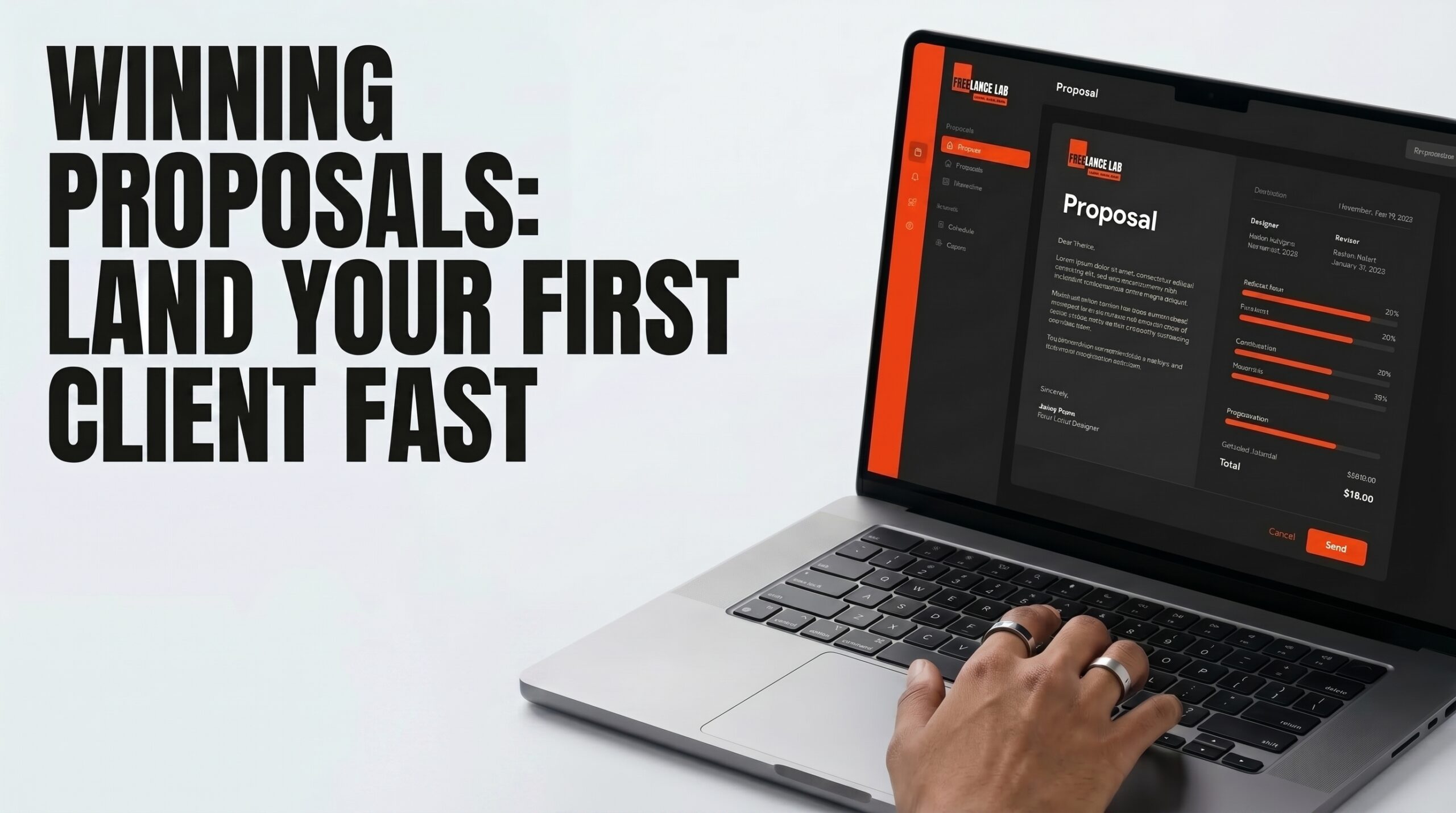
How to Write Freelance Proposals That Help You Land Your First Client
If you have ever tried finding freelance work for the first time, you have probably realised that learning a skill is only part of becoming a freelancer. The moment you begin applying for opportunities, a different challenge appears: knowing how to communicate your value convincingly.
A job gets posted on Upwork. A startup founder shares a requirement on LinkedIn. An agency seems to be looking for freelance support. And suddenly, many beginners find themselves staring at a blank screen, unsure what to say.
This is where momentum often breaks.
Some copy proposal templates from the internet. Others write long self-introductions hoping effort alone will create trust. Some send overly generic messages that could apply to any client. When no replies come, the assumption is often the same: I probably need more experience.
Usually, that is not the real issue.
The problem is proposal writing.
Because in freelancing, proposals are not formal documents designed to impress with complexity. They are business communication tools designed to create trust, demonstrate relevance, and make a client feel confident enough to continue the conversation.
What Proposal Writing Actually Means in Freelancing
A freelance proposal is not a personal biography, nor is it a place to list every skill you have learned.
Its purpose is much simpler: helping a potential client quickly understand whether you grasp their requirement, whether your capability feels relevant, and whether working with you seems low-risk.
This is where many beginners go wrong. Instead of addressing the client’s problem, they focus heavily on themselves—describing how hardworking, passionate, or committed they are without offering meaningful context.
Clients are not evaluating enthusiasm in isolation.
They are evaluating fit.
The strongest proposals are not necessarily the most polished or formal. They are the ones that feel relevant, thoughtful, and professionally clear.
Why Most Beginner Proposals Fail
Most weak proposals fail not because the freelancer lacks skill, but because the communication lacks positioning.
Generic proposals immediately feel copy-pasted, which lowers trust. Overly long introductions create friction instead of clarity. Desperate language such as “Please give me one chance” weakens professional credibility rather than improving it.
Another common mistake is talking too much about capability without showing understanding of the client’s actual need.
Clients are not hiring freelancers simply to complete tasks.
They are hiring outcomes.
A business needing blog content wants audience education or traffic growth. A founder hiring for social media support wants visibility or engagement. A startup looking for design support wants stronger brand communication.
The moment you understand that distinction, proposal writing becomes significantly easier.
A Practical Proposal Framework You Can Actually Use
Instead of writing every proposal from scratch, it helps to work with a simple repeatable structure:
CONNECT → CLARIFY → POSITION → PROVE → CLOSE
Connection means showing that your message is specifically relevant to the client rather than copied from a template. Clarification demonstrates that you understand what they are actually trying to achieve. Positioning is where you explain why your skill or approach makes sense for that requirement.
Proof builds trust through relevant samples, related work, or practical evidence of competence. Closing creates a clear next step so the conversation can move forward naturally.
This framework keeps proposal writing structured without making it feel robotic.
Weak Proposal vs Stronger Proposal
The difference between poor and effective proposals becomes much clearer through comparison.
A weak beginner proposal often sounds like this:
“Hello Sir/Madam, I am very interested in your project. I have excellent communication skills and I can complete this work perfectly. Please give me one chance. I am hardworking and passionate.”
There is effort here—but very little relevance.
Now compare that with a stronger version:
“Hi [Client Name], I noticed you’re looking for blog content that helps educate your audience around fintech topics. I recently created similar long-form content focused on simplifying complex subjects for readers, and your requirement immediately stood out because that type of writing aligns closely with my strengths. Happy to share relevant samples and understand more about the outcomes you’re targeting.”
The difference is not complexity.
It is clarity, specificity, and professionalism.
Practical Tricks That Instantly Improve Proposal Quality
Strong proposal writing is not just about wording. Preparation matters.
One of the easiest ways to improve proposal quality is spending five minutes researching before writing. Checking the company website, reviewing their LinkedIn presence, or looking at their existing content gives immediate context around what they sell, how they communicate, and what business problem they may actually be trying to solve. That small preparation step allows your proposal to reference something real instead of sounding generic.
A few practical tools can also improve your process significantly.
Grammarly helps clean obvious writing mistakes before sending anything client-facing. Notion or Google Docs can help you maintain reusable proposal frameworks so you are not rewriting from zero every time. ChatGPT, when used responsibly, can help refine phrasing or improve clarity—but should never become a blind copy-paste engine.
For freelancers pitching directly, Loom can occasionally create differentiation through short video introductions, particularly in service categories where trust matters heavily.
The goal is not automation.
It is better execution.
Proposal Writing Is Useful Beyond Freelance Platforms
Many beginners assume proposal writing only matters on freelance marketplaces.
It does not.
The same principles apply when reaching out to potential clients on LinkedIn, sending direct cold emails, approaching agencies, or pitching startup founders informally.
The platform may change.
Professional communication principles do not.
That makes proposal writing one of the most transferable client acquisition skills a freelancer can build early.
Final Thought
Landing your first freelance client is not only about learning a skill.
It is also about communicating that skill in a way that builds trust.
Proposal writing matters because it shapes first impressions, reduces uncertainty, and creates opportunities for real conversations. Your early proposals may not convert immediately, and that is completely normal. Like any business skill, this improves through repetition, feedback, and deliberate refinement.
Because freelancing is not just about being capable of doing the work.
It is about positioning that capability clearly enough for someone to say yes.